
About Us
Our Grip On God’s Word
the History
While the presence of Lutheran Churches in Oconomowoc was fairly well established and rooted by the early 1970’s by the larger Lutheran Synods of America, there was no church in the area from the Lutheran Church in America (LCA). Through the vision of the Mission Board of the Lutheran Church in America, land was purchased in 1975 at Lord of Life’s present location on the northeast corner of Cty. Roads P & Z.
Thus, a small Lutheran Church on the northeast side of Oconomowoc was poised to strengthen it’s grip on the truth of God’s Word and the certainty of salvation and share it with the surrounding community. Because of Lord of Life’s grip on the truth of God’s Word, the congregation united around these foundational beliefs of Holy Scripture on which confessional Lutherans stand: “By Grace Alone, By Faith Alone, By Scripture Alone.”
Not long after Lord of Life’s 10th anniversary on April 5, 1987, this congregation joined the Evangelical Lutheran Church in America (ELCA) in 1988. The decision was later made, and we currently are, a member of the NALC, North American Lutheran Church.
Hear From Pastor Mike
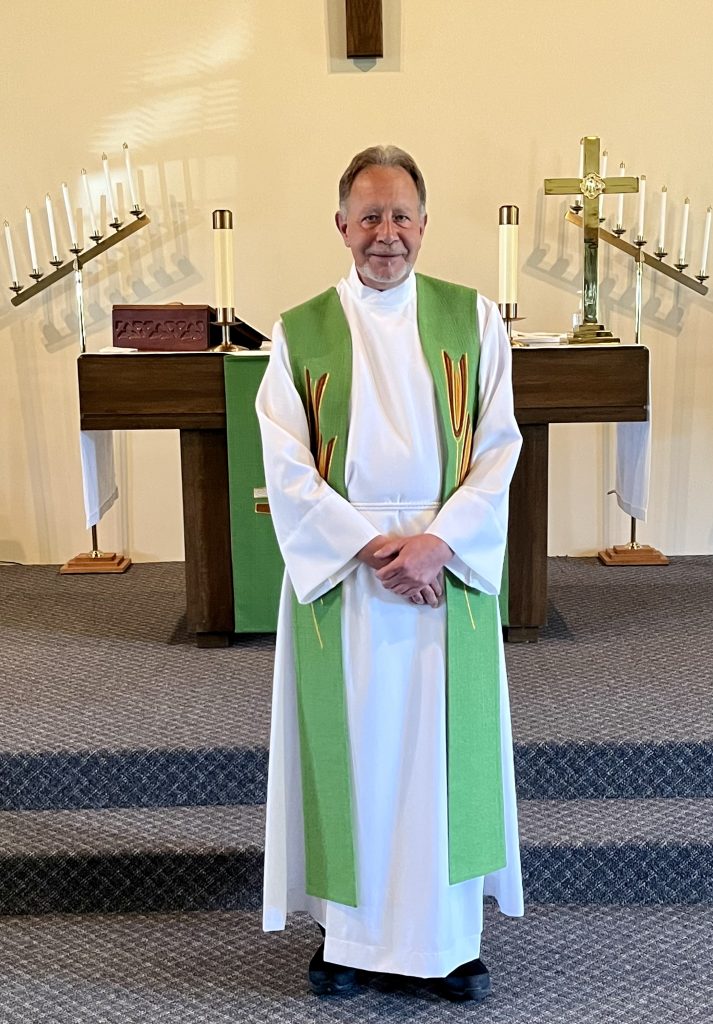
April 2026
Pilate asked, “What is truth? — John 18:38
Good question, Governor Pilate.
If you have known me for any length of time, you know I am a man in search of the truth. My interest in philosophy is not because I love to hear people ramble through 800 pages about conclusions that could be summed up in three sentences. I am more like a prospector, looking for nuggets of truth in a riverbed of sand. Even the most ardent of skeptics can speak truth with clarifying candor. One of my favorite theologians, A.W. Tozer, once asked a fellow pastor whether there was any benefit in reading secular literature. He replied, “Young man, a bee can find nectar in the weed as well as in the flower.”
Pilate’s question regarding truth has puzzled theologians throughout the centuries. Because written words cannot express the tone, we do not know if he was being sarcastic or reflective. Either way, it stands as a valid question, especially in 2026. A recent Barna Research Study asked people, “Is there absolute Truth?” 66% of respondents chose this answer: “There is no such thing as absolute truth; different people can define truth in conflicting ways and still be correct.” Apparently, philosophy, logic, and laws of nature are no longer valid. I am looking forward to meeting the person that does not believe the rate of gravity on earth is 32.2 feet per second squared.
Context is important. Pilate’s question was a response to something Jesus had said: “Everyone on the side of truth listens to me.” It seems that Pilate took our Lord’s words to heart. His next words were to the crowd: ““I find no evidence of a crime in this man.” It was a truth that the crowd did not want to hear. We know the result.
As Christians, we sometimes confess truths the world does not want to hear. We preach that all people are sinners in need of a Savior. We proclaim a Messiah who gave His life as a sacrifice for our sins. We believe that three days after His execution, He came back from the dead. The Apostle Paul spoke the truth when he wrote, “We preach Christ crucified: a stumbling block to Jews and foolishness to Gentiles.” Yet, it is this truth upon which the Church stands or falls. And the fate of every human soul rests in its response to this truth.
The early church (as shown in the Bible) met on Sundays because they felt every worship should be a celebration of the Resurrection. To put it another way, every Sunday was Easter for them. It was known as “The Lord’s Day.” When we gather on Sunday morning as the children of God, we stand as witnesses to the historical fact that Jesus rose on the first day of the week. Truth is not a concept; truth is a Person, arisen and ever alive! He is the only One who could truthfully say, “I am the way and the truth and the life. No one comes to the Father except through me” (John 18:6).
Winston Churchill once said about his adversary Prime Minister Stanley Baldwin, “He occasionally had stumbled over the truth, but hastily picked himself up and hurried on as if nothing had happened.” Such was the fate of Pilate. He wanted to know what truth was when the truth was standing before his very eyes. His fatal mistake echoes through the hallways of history, making the name “Pontius Pilate” forever infamous. God preserves us from making the same mistake!
Your servant in Christ,
Pastor Mike
March 2026
“He was oppressed and afflicted, yet He did not open his mouth; He was led like a lamb to the slaughter, and as a sheep before its shearers is silent, so He did not open His mouth.”
—Isaiah 53:7
When it comes to sins of the tongue, we often think of the obvious ones: cursing, gossip, lies. Two of the Ten commandments (the 2nd and the 8th) deal directly with sins of speech. The tongue was created for good things like tasting food, singing hymns and proclaiming the Gospel. But along with the rest of creation, it can be turned toward the negative. The Apostle James gives us a fine and colorful admonition in the 3rd chapter of his epistle:
“All kinds of animals, birds, reptiles and sea creatures are being tamed and have been tamed by mankind, but no human being can tame the tongue. It is a restless evil, full of deadly poison. With the tongue we praise our Lord and Father, and with it we curse human beings, who have been made in God’s likeness. Out of the same mouth come praise and cursing. My brothers and sisters, this should not be.”
I like to think of the tongue as a faucet, a conduit for the refreshingly cool or the dangerously hot.
.
Jesus is the only person who ever had His tongue under complete control. Not only did He know when to speak but also what to say. One of the sins of the tongue we rarely think about is the “excessiveness of words.” Proverbs 10:19 states, “Sin is not ended by multiplying words, but the prudent hold their tongues.” We have frail egos. When we feel we are under attack, we naturally defend ourselves through excuses, explanations, and rationalizations. It is human nature to use a torrent of words when a simple and sincere “I’m sorry” would accomplish so much more.
For the most part, Jesus remained silent before His accusers, both religious and political. When Jesus stood before Pilate, Herod, and the high priests, He was falsely accused, mocked, and beaten. Yet He did not offer a defense to escape the cross. His silence was not a sign of weakness, but one of strength and purpose. But He also knew when to speak up—for the truth! After the High Priest put Him under oath and asked if He was the Messiah, He answered in the affirmative. When Pilate asked if He was King of the Jews, He also answered “Yes.” Men judged His answers as blasphemy and treason. However, Jesus knew that his suffering was the ultimate plan of the Father for the redemption of humanity. He did not speak because he was fulfilling his role as our Passover Lamb, taking upon himself the sins of the world. His submission demonstrates His obedience to the Father and His commitment to pay the price for our peace.
In our world today, the natural response to injustice is to raise our voices. We demand our rights, defend our reputation, and protest unfair treatment. Yet, 700 years before the birth of Christ, the prophet Isaiah painted a profoundly different picture of the Messiah—a picture of silent submission. We are called to follow His example of trusting God during unjust trials. 1 Peter 2:21-23 advises;
“To this you were called, because Christ suffered for you, leaving you an example, that you should follow in His steps. ‘He committed no sin, and no deceit was found in His mouth.’ When they hurled their insults at Him, He did not retaliate; when He suffered, He made no threats. Instead, He entrusted Himself to Him who judges justly.”
Saint Augustine had a marvelously short prayer in this regard: “O Lord, deliver me from this lust of always vindicating myself”. Sometimes, silence can be deafening.
Your servant in Christ,
Pastor Mike
February 2026
“Teach me Your way, Lord, that
I may rely on Your faithfulness.” –Psalm 86:11
As I sit in my nice, warm office (complete with fireplace thanks to the Burants!), the temperature outside is hovering around –11. That is not just cold—with the wind chill, it is deadly cold. There was a time when I appreciated blizzards and sub-zero temperatures, namely, when I was a student. Harsh weather conditions meant a day when I could relax or play at home, instead of sitting at a desk for 8 hours. Even on a day deemed by the adults as too dangerous to travel, I could always survive a walk to my buddy’s house several blocks away.
I am no longer in school, but I am still a student. If you have spent any time at Lord of Life, you have heard me say repeatedly the word “disciple” is not some piece of specialized nomenclature. It simply means “student.” In the ancient world, both philosophers and rabbis had disciples, students who would learn at the feet of their master. In following that tradition, I try to make every worship service at Lord of Life a learning experience, along with the prayers and the praise. Sometimes, that entails reminding people of what they already know. Other times, it is imparting new information.
Our theme for February is “School on the Hill” because that is where Jesus gave some of His greatest lectures on the Kingdom of God. We will be looking at two portions from the Sermon on the Mount. Then we will watch as our Heavenly Father gives us another lesson on the Mount of Transfiguration. Because these events are so well-known to us, it is easy to miss their deeper meaning. That means that we will need to be especially attentive to what God is saying with these familiar words.
Even though I appreciated the “snow days” of my youth, I was also one of those weird kids who liked school. From elementary school to post-graduate work, I was thirsty for knowledge. Apparently, so was King David because he wrote “Teach me Your way, Lord.” The book David had to learn from was the Torah, the first five books of the Bible. This great king knew that God had revealed Himself on those scrolls and he wanted to delve deeper into the mind of the Lord. But that was not the only place David would discover truths. He also learned lessons, sometimes very harsh ones, in what many call the “school of hard knocks.” Life taught him some hard truths. David realized it was not just enough to learn something; we must also live out what we have learned.
As we enter the Lenten season, we too can sit at the feet of our Master and learn new truths. Lent is a time of discipline for what are known as “spiritual exercises.” If you do not already do so, I want to encourage you to give up five minutes of every day in reflecting upon the word of God. An excellent resource in this regard is the “Portals of Prayer” magazine that we have for free in our church narthex (including the large-print ones that are now available through the generosity of one of our members). Each month’s devotions are written by a different author. The current edition has devotions from a pastor’s wife, a now retired pastor Tom Kaul (a friend of mine from seminary), and a professor of music emeritus from Concordia University in Mequon. It is good to hear the Gospel proclaimed through different perspectives and is an important part of growing in knowledge and truth. During grade school, most of us had the same teacher all day long. But when we reached the high school level, we had different teachers for various subjects. Sunday morning worship is a vital lifeline to leading the Christian life. But a short devotion every morning is a daily “infusion.”
Your servant in Christ,
Pastor Mike
January, 2026
“Sing to the LORD a new song,
for He has done marvelous things.”
— Psalm 98:1
I do not think I am different from most folks when I say sometimes I get a song stuck in my head. For me, this often happens at the end of Sunday worship as the final hymn keeps
silently repeating in my mind for the next hour or two. At times, I even find myself humming it out loud. Stranger still is that sometimes I wake up in the morning with a song in my heart. Today, I could not get “Rockin Around the Christmas Tree” out of my head during my morning routine. It is a nice song, but not very Christ-centered.
When a song on the radio is especially catchy or melodic, it is called an “earworm” (no need to consult your physician). Apparently, a lot of music in our church has the same effect. Most of us probably have a favorite hymn; some of us may have a dozen or more. Our hymnal is replete with songs that have stood the test of time, sometimes centuries of time. One of our hymns, “Of the Father’s Love Begotten,” has words that stretch back to the 4th century A.D.! Add to that the fact that portions of our liturgy are based upon verses from the Old Testament, and it is plain to see that music is an important part of the heritage
between the ancient church and the modern one.
In the verse above, the Psalmist tells us that we are to sing a “new song” to the Lord. In this context, the word “new” does not necessarily mean a song or a melody we have never heard before. If I had to write several new songs for every Sunday service, we would be in big trouble. Not to mention, congregational singing would diminish to a low murmur. The idea is that we should be singing the songs we already know with renewed vigor and vitality. In other words, don’t just sing words on a page; put your heart into it! It was Jesus who told us the type of worshippers the Father is looking for: those who worship God in
spirit and truth (John 4:23). Even though we are a small congregation, I love it when we raise our voices in a hymn which is meaningful to many of us. Sometimes, my heart soars when I hear Lord of Life belt out “On Eagle’s Wings!”
The Psalmist also points out the motivation for revitalized emphasis in our singing: the Lord has done marvelous things for us! That means being open to a fresh experience of God’s power and salvation. It also entails keeping our eyes open to the beauty of creation, the resilience of the human spirit and the quiet ways God guides us through uncertain
times. Even in times of war or economic hardship, “Silent Night” can bring peace to the restless soul much like a lullaby sung by a parent to a beloved child.
It is interesting to note that the same word used for “new” song is the same word used for the “new” moon. Obviously, a new moon is not created from scratch every 28 days. We just see it from a new perspective. Let us thank God for our rich repository of music within our Lutheran heritage. May every hymn be a love song dedicated to the God we adore!
Your servant in Christ,
Pastor Mike
December, 2025
“In His name the nations will put their hope.” –Matthew 12:21
Throughout the month of December, we will continue our theme
of “Hope for the Holidays.” The verse above is actually a quotation from the book of Isaiah, a Messianic prophecy of some future time when the God of Israel would make Himself known to other nations. Israel held a very unique place in the ancient world, being the only nation that worshiped one God. While there were some converts to Judaism throughout the centuries, Israel had never implemented an organized “evangelism program.”
We should not forget that the first Christmas was a strictly
Jewish event. Mary and Joseph were Jewish. The innkeeper with a “No Vacancy” sign was Jewish. The shepherds who came to worship the newborn were Jewish. Powerful Romans like Caesar Augustus and
Quirinius were peripheral pawns in the unfolding of divine history. It would take two years before Magi from the East would come to worship the Christ toddler. This was the first indication that Jesus had come to earth not just as a Messiah for Israel, but as the Savior for our entire world.
What you may not know is that Christmas, as wecelebrate it now, has a long and varied history. December 25th was not chosen as the date to commemorate Jesus’ birthday until 336 A.D. (no one knows the real date of His birth). The early Church existed for three centuries without celebrating the Nativity.
During the Middle Ages, Christmas got a bad reputation as a holiday of debauchery and drunkenness. It was neither a silent night nor a holy one! Things got to the point where the English parliament outlawed any Christmas celebrations, religious or secular, from 1647 until 1660. The ban was very unpopular and caused riots in several cities.
The first British colonists to the “NewWorld” followed suit. The Massachusetts Bay Colony, being made up of Puritans
who migrated from England, banned Christmas in 1659. A fine of 5
shillings was levied against anyone who was caught celebrating the
holiday. Although these harsh mandates would be repealed in
1681, businesses and schools in Massachusetts remained open
on Christmas, while most churches remained closed, well into the
mid-1800’s. Scrooge and the Grinch had nothing on these guys!
It took immigrants from other nations to introduce the Christians traditions we hold so dear today. Germans brought the tradition of decorating a tree and gingerbread houses into American culture. Victorian Britian initiated the practice of caroling during the holidays. The French brought the practices of feasting and gift-giving. The Scandinavians introduced the custom of hanging stockings to be filled with goodies. In other words, Christmas as we know it today is the result of many nations coming together.
What began in a small corner of Israel, with a cast of ragamuffin Jews, is now a birthday party celebrated worldwide. The prophecy of Isaiah has come true, with people from every nation placing their hope on the One laid in a manger. And the best news is the same promise He gave to Israel before they would enter the Promised Land: “He will never leave us, nor forsake us” (Deuteronomy 31:8).
Merry Christmas and a blessed New Year toall of you! God is with us!
Your servant in Christ,
Pastor Mike
November, 2025
“In this hope we were saved. But hope that is seen is no hope
at all. Who hopes for what they already have?”
— Romans 8:24
I have a confession to make, and I trust I am not the only
one. As a child, I knew where my parents hid the Christmas gifts
before they were wrapped. In the weeks leading up to Christmas, my sister and I would stealthily creep into my parents’ bedroom, open their closet door and stare at all the treasures that had yet to be clothed in
“swaddling wrapping paper.” Of course, we could not play with any of the
gifts; we dare not even open the boxes. But we could anticipate all
the joy we would have on Christmas Eve when this trove would officially be
ours. The surprise of what we were getting would be gone, but
the anticipation remained.
This was back in the “days of old” when department stores waited
until after Thanksgiving before they made their holiday push. By the time this is printed, you probably have seen half a dozen or more Christmas displays. Halloween is now the watershed dividing the holiday season from the rest of the year. And it doesn’t stop there. There is
a Milwaukee radio station that began interspersing Christmas songs with their regular playlist on August 29 this year! I guess some
people want to hear “Let it Snow” when the temperatures are in the high
80’s.
Our theme for the months of November and December is
“Hope for the Holidays.” I believe all of us will admit that the holidays for an adult are different than for a child. “What am I going to get?” has been replaced with “What am I going to give?” Who is going to host the Thanksgiving Dinner? Where will the family gather for Christmas? Should I put up the outdoor lights this year? Time constraints, mandatory appearances, and obligatory gifts can place us in a state of anxiety rather than anticipation. Are there no surprises left?
What we need is a change of perspective. We cannot go back in
time, but nothing prevents us from seeing the holidays through the
eyes of a child. After all, it is that kind of faith that Jesus held up as an example for all. When the first snowfall hits our area, do not grumble about the shoveling or worry about road conditions; thank the Lord for the beauty of the seasons. Go out and catch some snowflakes on your tongue!
Take your eyes off the turkey and stuffing this Thanksgiving and
look deep into the eyes of all the people God has given you to love—and who love you as well!
As the children perform their Christmas program in December, sing
with them in your heart and praise God He is carrying on the faith to the
next generation.
As Christmas nears and you see a nativity scene, take some time to meditate upon that first Christmas and the miracle of “God with us.” When the Spirit of God comes upon you, you may be shocked to find out that there are still a lot of surprises to the holidays.
Hope for the holidays means that our seasonal meals are
but a “foretaste of the feast to come.” It means that the gifts we
give and receive are but a shadow of God’s greatest gift to a waiting world.
Most importantly, from manger to cross to empty tomb, it reminds us that the
best is yet to come. Like kids who find a cache of gifts prepared
for them, but cannot quite enjoy them yet, we wait in expectant hope. We know what awaits all of God’s children but, when it is finally ours, it will be more splendid and surprising than anything we could have ever imagined.
Your servant in Christ,
Pastor Mike
Lorem ipsum dolor sit amet, consectetur adipiscing elit. Ut elit tellus, luctus nec ullamcorper mattis, pulvinar dapibus leo.